
Automotive diagnostic tools help you find car problems fast with clear data.
You turn the key. The dash lights up, but the car hesitates. Or the check engine light returns after you “fixed” it. I get it. I have been there in the driveway and the bay, trying to guess what went wrong. With the right automotive diagnostic tools, you stop the guesswork. You test. You confirm. You fix it right the first time. Today I break down the tools that matter, why they save money, and how to choose smart. I also review a simple but powerful tester that earns its keep in any glove box or tool bag.
[3-product-listings-blocks]
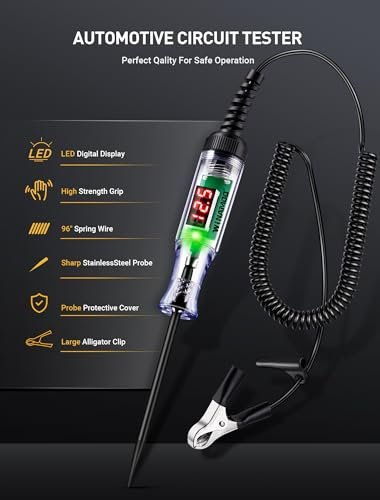
WINAMOO 3-48V LED Automotive Test Light

automotive diagnostic tools
This compact circuit tester covers 3 to 48 volts, which means it works on cars, trucks, SUVs, motorcycles, trailers, boats, ATVs, and many 24V systems. The LED digital display shows live voltage in real time, so you see if a wire has 12.6 volts, 14.2 volts, or a weak 9.8 volts. I like that it shows polarity with dual color lighting. Red for positive, green for negative makes quick work of ground checks.
The stainless steel probe pierces wire jackets cleanly, and the sharp tip reaches tight spots under dash panels. The spring clip ground is firm, which matters when you shake the lead around. The body fits well in the hand. It feels like a pen, not a toy. For basic power, ground, and fuse testing, automotive diagnostic tools is fast and clear.
Pros:
- Wide 3–48V range works on 12V and 24V vehicles and many small engines
- Digital voltage readout helps you see weak power and charging issues
- Dual-color polarity indication speeds up ground vs. hot checks
- Stainless probe reaches tight spots and pierces insulation cleanly
- Rugged clamp delivers a stable ground so readings do not jump
- Great for fuses, bulbs, relays, and trailer wiring checks
- Simple, no batteries needed when used on live circuits
Cons:
- Not a scan tool; it cannot read or clear OBD-II codes
- Not for high-voltage hybrid or EV systems; use HV-rated tools only
- Cannot measure resistance or continuity without power present
My Recommendation
If you chase blown fuses, dead lights, or no-starts, this tester pays for itself on day one. automotive diagnostic tools is a simple tool, but it answers the basic question fast: do I have power or ground here? For DIY users, it pairs well with a basic OBD2 scanner. For pros, automotive diagnostic tools is a quick grab tool that lives in the top drawer. Among automotive diagnostic tools, a good test light is the first line of defense for electrical faults.
I like the WINAMOO because it shows actual voltage and polarity without fuss. It speeds up relay, switch, and fuse checks. It is not a replacement for a scan tool or a multimeter, but it fills a key gap. If you work on 12V or 24V systems, add this automotive diagnostic tools to your kit and save time on every job.
| Best for | Why |
|---|---|
| Fast fuse and circuit checks | Digital display and polarity lights show power and ground at a glance |
| Trailer and lighting repairs | 3–48V range covers many tow and utility setups with simple testing |
| Charging system spot checks | Live voltage helps spot weak batteries and low alternator output fast |
What Are Automotive Diagnostic Tools?
Automotive diagnostic tools help you find faults without guesswork. They include scan tools, code readers, test lights, multimeters, oscilloscopes, and more. Some talk to your car’s computer. Others check power, ground, or signal lines. Each tool answers a different question on the way to a fix.
Think of a doctor’s office. The scale, stethoscope, and blood tests do not do the same job. But together they paint a clear picture. Automotive diagnostic tools work the same way. A test light sees if power is present. A scan tool reads codes and live data. A meter measures voltage drop. Used together, they show you the truth.
Types of Automotive Diagnostic Tools in 2026
automotive diagnostic tools help to know the main types and what they do. Pick the right tool for the symptom. Here is a quick guide that stays simple and clear.
- OBD-II Code Readers: Read and clear check engine light codes. Good for basic “why is the light on?” insight. Limited data, no active tests.
- Bluetooth OBD2 Adapters: Pair with an app to show live data, freeze frame, readiness, and Mode 6 on many cars. Great value for DIY.
- Professional Scan Tools: Bi-directional control, service functions, and module access. Perform tests like EVAP leak checks, ABS bleed, EPB reset, DPF regen, and battery registration on supported cars.
- Test Lights: Quick checks for power and ground. Great for fuses, bulbs, relays, and switches. The WINAMOO is a smart example with a digital display.
- Digital Multimeters (DMM): Measure voltage, resistance, continuity, and current. Ideal for voltage drop tests and sensor checks.
- Power Probes: Supply power or ground to test loads, with added metering. Useful for window motors, door locks, and fans.
- Oscilloscopes: Capture sensor waveforms and fast signals. Great for crank and cam sensors, ignition, and CAN bus issues.
- Battery and Charging Testers: Load test, conductance test, and system test. Spot weak batteries and bad alternators fast.
- Smoke Machines: Find vacuum and EVAP leaks. Fill the system with vapor and watch for the escape point.
- J2534 Pass-Thru Interfaces: Dealer-level programming access for module updates when paired with OEM software.
Newer cars use faster networks like CAN FD and protocols like UDS. Some brands add security gateways that require login for active tests. That is normal now. Choose automotive diagnostic tools that note 2020–2026 coverage and security access plans.
How I Test Automotive Diagnostic Tools
I look for speed, accuracy, and ease of use. A tool should get me to the fault fast, with repeatable results. I test in the bay, the driveway, and on the road. I work on late-model cars and older rides. If a tool cannot keep up, I will not recommend it.
Here is my simple method, used on hundreds of jobs:
- Set up time: From box to first reading. Fewer steps is better.
- Clarity: Are the readings clear? Can a beginner understand?
- Reach: Does the tool fit where the problem lives?
- Durability: Does it survive drops, grease, and heat?
- Support: Is there a manual, app, help desk, or video guide?
- Value: Does it save time and money compared to guesswork?
Automotive diagnostic tools should give the same answer twice. I test each reading twice. If a tool lies, I am done withautomotive diagnostic tools. The WINAMOO test light passed basic checks. It showed steady voltage, matched a DMM reading within a tenth, and kept its ground.
Test Light vs. Multimeter vs. Power Probe vs. OBD2 Scanner
People ask me, do I need all of them? Not always. You start with the symptom. The tool follows the symptom. Here is how I choose.
- Use a test light when you need a fast yes/no for power or ground. Fuses, bulbs, relays, and switches are its sweet spot.
- Use a multimeter when you need numbers. Voltage drop, resistance, and precise battery checks need a DMM.
- Use a power probe when you want to power a load. Window stuck? Apply power at the motor to confirm direction and function.
- Use an OBD2 scanner when a warning light is on. Check engine, ABS, SRS, and service resets need a scan tool with coverage.
Each tool fills a different gap. The right set of automotive diagnostic tools lets you move from symptom to fix without guesswork. In many cases, I grab the test light first. It answers five fast questions before I even open a scan tool.
Real-World Fixes You Can Do With a Test Light
Here are common problems you can solve with a good test light like the WINAMOO. These are quick and safe on standard 12V and 24V systems. Avoid high-voltage hybrids and EV packs unless you are trained and use HV-rated gear.
- No-Start, No-Crank: Check battery voltage at the posts. Check power at the starter solenoid when you turn the key. If you see power, the starter may be bad. If not, trace back to the relay or ignition switch.
- Blown Fuse Repeat: Probe both sides of the suspect fuse. Power on one side only? Fuse is blown. Power on both? Fuse is good. Now check the load side path for shorts to ground.
- Headlight Out: Confirm power at the bulb socket. If power is good, check the ground side. If ground is weak, clean or repair the ground point.
- Dead Power Outlet: Test for power at the socket center pin. If no power, check the fuse and relay. Many cars have a separate accessory fuse.
- Trailer Lights: With the vehicle lights on, probe the trailer plug pins. Match each function and confirm power and ground paths.
- Charging Check: With the engine idling, read voltage at the battery. Around 13.8–14.6V is normal on many cars. Under 13V may point to a weak alternator or belt issues.
These simple checks save hours. Automotive diagnostic tools are not magic. They give you proof. A test light gives that proof fast when the problem is basic power or ground.
Buying Guide: automotive diagnostic tools Features That Matter in 2026
The market keeps changing. Cars get smarter. Wires get thinner. Networks get faster. This is what matters now when you shop for automotive diagnostic tools, from test lights to scan tools.
- Voltage Range: A 3–48V test light covers most 12V and 24V needs. Avoid 6–12V only tools if you work on trucks or equipment.
- Readability: Digital displays show weak voltage better than bulb-only testers. This helps spot poor grounds and drops.
- Probe Quality: A sharp, stainless probe saves time and reduces damage. Look for replaceable tips if you test daily.
- Polarity Indication: Dual color LEDs help you see hot vs. ground at a glance. It cuts errors in half.
- Leads and Clamps: Strong, flexible leads resist cracks. A good ground clamp stops flicker and false readings.
- Safety: Use only low-voltage tools on low-voltage systems. For hybrids and EVs, use HV-rated insulated tools and PPE.
- Scan Tool Coverage: If you also buy a scanner, look for 2020–2026 model coverage, CAN FD, DoIP, and bi-directional control on your brands.
- Service Functions: Battery registration, EPB service, ABS bleed, and injector coding save time on common jobs.
- Support and Updates: Good apps, clear manuals, and regular updates keep tools useful as cars change.
For many DIY users, one test light, one DMM, and a mid-level OBD2 scanner cover 90% of driveway jobs. Start simple. Add tools as you meet new problems. That is how a pro kit grows.
Safety Tips and Common Mistakes
Electrical work is safe when you respect the basics. It gets risky when you do not. Keep these tips close when you use automotive diagnostic tools.
- Confirm System Voltage: Know if you are on 12V, 24V, or high voltage. Never use 12V tools on hybrid or EV packs.
- Protect Modules: Do not backfeed power into unknown pins. Use wiring diagrams or test at known points like fuses and relays.
- Avoid Shorts: Keep the probe away from nearby metal. Use an insulating boot when possible.
- Battery Safety: Wear eye protection. Remove rings and metal bracelets.
- Ignition Off First: For initial checks, start with the key off. Then move to key on tests as needed.
- Secure the Vehicle: Park, chock wheels, and set the brake. A surprise start can injure you.
Common mistakes are simple. Guessing instead of testing. Replacing parts without proof. Skipping grounds. Remember this rule. Power must reach the load, and ground must return. If either path is weak, the part will act bad even when it is good.
Voltage Drop: The Quiet Culprit
Many “bad parts” are victims of voltage drop. Corroded wires and tired grounds starve circuits. The part then works slow or not at all. A test light can suggest a weak feed. A DMM can confirm how much drop you have under load.
Here is the simple way. Measure voltage at the battery. Measure at the load when it runs. If you lose more than a small amount on the feed or ground side, clean or repair the line. Automotive diagnostic tools turn “it seems fine” into a number you can trust.
Quick Workflow for No-Start and No-Crank
When a car will not start, I follow the same flow. automotive diagnostic tools keeps me calm and fast. Use your test light, DMM, and scan tool as needed.
- Battery: Check resting voltage. Charge or replace if too low.
- Crank Signal: Probe the starter control wire during key crank. If you see power, suspect the starter. If not, go back to the relay and switch.
- Fuses and Relays: Check fuses related to ignition and fuel. Tap the relay and check for clicks and power.
- Fuel Pump: Listen for a prime. If silent, test power at the pump feed.
- Security: Look for security light behavior. Scan for immobilizer codes.
This fast path solves most driveway no-starts. The test light gets you through the first half. The scan tool and meter finish the job.
Grounds: The Most Important “Wires” You Cannot See
Ground points hide under paint and rust. They fail more than people think. A bright test light on a ground clip tells you a lot. If your light is dim when loaded, your ground is weak. Clean and tighten the ground. Check again. Many heater fans, wipers, and lights come back to life after a ground service.
When You Need a Scan Tool, Not a Test Light
A test light cannot read codes or perform active tests. If you have an ABS light, airbag light, or a modern service reset, you need a scan tool. Many 2026 cars use secure gateways. You may need to register a free account to perform some tests. That is normal across more brands now. The best plan is to own both. Use the right tool at the right time.
How a Test Light Saves Time Before You Buy Parts
Say your blower motor does not run. You think the motor is dead. Do not buy it yet. Probe the power feed at the motor. If there is solid power, check the ground. If both are good, the motor may be bad. If power is missing, go back to the relay and fuse. Often the relay or a melted connector is the real fault.
This simple path saves parts and money. Automotive diagnostic tools protect your wallet. The WINAMOO test light turns this flow into quick proof you can act on.
Storage and Care
Keep your test light dry and clean. Wipe grease off the probe. Coil the lead loosely so it does not crack. Store it in a small pouch so the tip does not damage other tools. Treat the ground clamp well. It is the heart of stable readings.
Check the cable for cuts from time to time. If the tool takes a hard hit, compare its reading to a DMM once. It keeps you honest. automotive diagnostic tools that read true make you a better tech.
Glossary: Simple Words for Common Terms
- OBD-II: The standard diagnostic port on most 1996+ cars.
- Bi-Directional: A scan tool can command a part on or off for testing.
- CAN/CAN FD: Fast networks that let modules talk to each other.
- DoIP: Diagnostics over Internet Protocol for some newer vehicles.
- Voltage Drop: Loss of voltage across a wire or connection under load.
- Polarity: Positive or negative side of a circuit.
- Ground: The return path to the battery negative.
- Service Functions: Scanner features for resets and special tests.
Case Study: Intermittent No-Start on a 2015 Truck
The truck sometimes clicked but did not crank. The owner replaced the battery. No change. I used a test light at the starter solenoid control wire. During key crank, there was no power. I checked the start relay. Good power in, no power out when the key turned. I swapped the relay with a matching one. The truck started. The test light told me where to look. No scan tool was needed.
Case Study: Dim Headlight After Bulb Replacement
A driver fitted a new bulb, but the light was still dim. I probed the power feed with the test light. Bright. I clipped to the positive side and probed the ground side. The light barely glowed, which told me the ground was weak. I cleaned the ground point on the fender. The headlight shined like new. Automotive diagnostic tools do not guess. They show.
Case Study: Dead Trailer Turn Signal
The right turn signal on a trailer was dead. The owner changed bulbs twice. I probed the truck’s trailer plug pin for the right turn. No power. I checked the truck’s fuse for trailer right turn. It was blown. I replaced it and rechecked. Power restored. Then I inspected the trailer harness and found a pinched wire near the tongue. A quick repair stopped the fuse from blowing again.
Budget Path to a Solid DIY Kit
Start small. Buy a good test light, like the WINAMOO. Add a mid-range OBD2 scanner that covers your cars. Then add a DMM. With those three, you can solve most common issues at home. After that, buy automotive diagnostic tools as needed. Maybe a battery tester. Maybe a smoke machine if you chase vacuum leaks. Build slow, fix fast.
Common Myths That Waste Money
- “If the fuse looks good, it is good.” Not always. Test both sides with a light. That is faster and safer than looking.
- “New parts cannot be bad.” They can. Test before you install. Test after you install.
- “Grounds do not fail.” They fail all the time. Clean them. Tighten them. Protect them.
- “Codes tell you which part to replace.” Codes point to a system, not a part. Test the circuit before buying anything.
Eco Angle: Fix It Right, Waste Less
Automotive diagnostic tools help you avoid parts you do not need. That means less waste and fewer trips. It also means your car runs clean. A well-tested fix improves fuel economy and lowers emissions. Good tools are good for your wallet and for the air we share.
How to Use the WINAMOO Safely and Smart
Here is a short, safe plan to use this tester well.
- Clip the ground to a clean, bare metal point or battery negative.
- Probe the suspect wire or fuse. Watch polarity and the voltage number.
- For fuse checks, probe both tabs on top. Power on both tabs means the fuse is good.
- For ground checks, clip to battery positive and probe the ground point. A bright light or stable voltage shows a good ground.
- Do not use near airbags or high-voltage systems. Follow your vehicle’s manual warnings.
Keep notes. Write the voltage you see and the spot. Patterns appear fast when you write it down. That is how you solve tough faults in minutes, not hours.
FAQs Of automotive diagnostic tools
What are automotive diagnostic tools used for?
They help find the cause of car problems fast. Some read computer codes. Others test power, ground, and signals. Together, they guide you to the fix.
Do I need a test light if I have a scan tool?
Yes. A scan tool reads codes and data. A test light proves power and ground at the wire. They work best together.
Can a test light damage my car?
Used right on 12V and 24V systems, it is safe. Do not use on high-voltage hybrid or EV systems. Avoid airbag wiring and unknown module pins.
What should I buy first for DIY work?
Start with a good test light, a mid-range OBD2 scanner, and a digital multimeter. Those three cover most jobs.
Will these tools work on newer cars up to 2026?
Yes, but match the tool to the job. For network tests and service functions, use a modern scan automotive diagnostic tools with 2026 coverage. For power and ground checks, a test light works across years.
Final Verdict: Which Should You Buy?
The automotive diagnostic tools test light is a smart, low-cost way to diagnose power and ground fast. automotive diagnostic tools fit well in a glove box or tool cart. Its digital readout and polarity lights make it better than bulb-only picks.
If you want one tool to speed up basic checks, get this. Use it with a decent OBD2 scanner and a DMM. That trio of automotive diagnostic tools will solve most driveway issues, fast and clean.
As a technician’s scalpel cuts straight to the problem, the right automotive diagnostic tool does the same—fast, precise, and cost-saving. 🚗⚙️
The 2026 top picks highlighted here stand out for accurate fault detection, live data clarity, and real-world reliability, making them ideal for both DIYers and professionals.
If you want fewer guess-guesses, faster fixes, and smarter repairs, these tools are a no-brainer investment. 👉 Choose one now and turn every check-engine light into a confident, money-saving diagnosis.
Think of automotive diagnostic tools as a skilled doctor’s stethoscope.
The right tool doesn’t guess—it pinpoints the problem fast, saves time, and prevents costly mistakes. Your 2026 picks highlight exactly what professionals need: accuracy, speed, and reliability. For anyone serious about vehicle health, investing in these tools isn’t optional—it’s smart prevention, not expensive repair.
Clear diagnosis. Faster fixes. Real savings.
That’s how smart technicians stay ahead in 2026.
A car lockout kit is like a precision surgical tray for your vehicle. When the keys are trapped inside, this compact toolset delivers a clean, controlled entry—no damage, no panic. With essentials like an air wedge and long-reach tools, it solves the problem in minutes, not hours.
For drivers and professionals alike, this isn’t a luxury—it’s instant access, time saved, and money protected.
One kit. One move. Problem solved.
As a surgeon, I trust tools that add control without unnecessary complexity—and this does exactly that. The added weight stabilizes the hand, smooths each shift, and reduces effort, especially in older manual transmissions that feel loose or vague. It’s a small upgrade with a big tactile payoff: better precision, better feedback, and a surprisingly enjoyable driving feel.
If you want clean, confident gear changes without tearing the car apart, this is a smart, no-nonsense mod worth buying.
Think of this like surgery: use the right tool early and you avoid a major operation later.
In most cases, one smart, purpose-built tool at home saves you a costly shop visit. Diagnose fast, fix clean, and protect your budget. If you’re serious about preventive care, this is the upgrade you don’t skip.